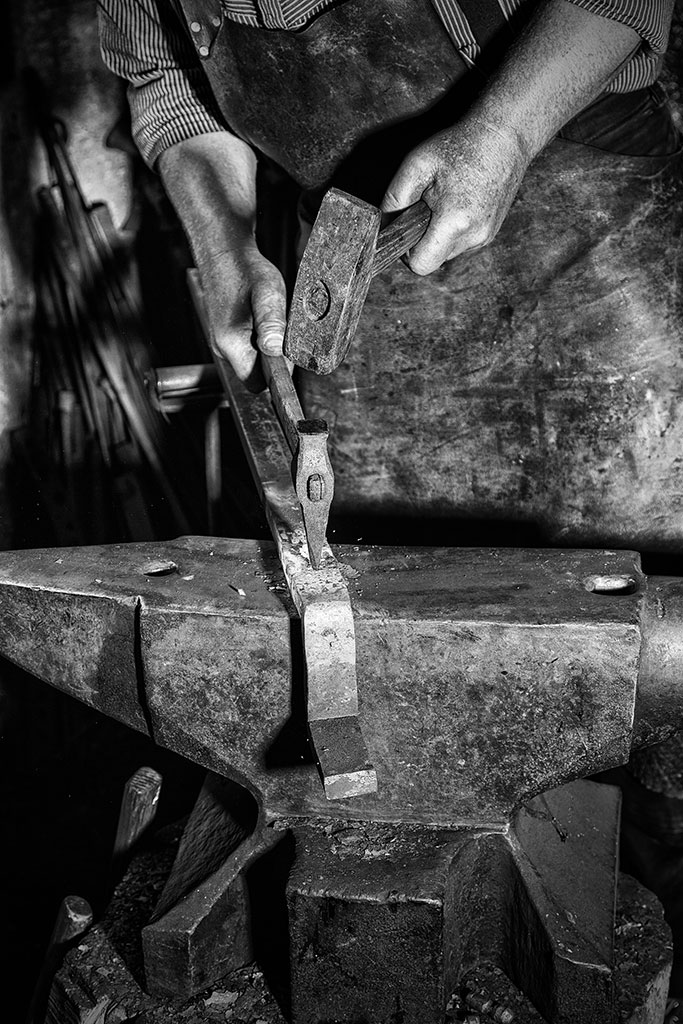
Wrought iron is shaped through a set of operations that have remained fundamentally unchanged since the early medieval period. The material responds to heat and mechanical force in ways that differ from modern mild steel, and an understanding of those differences is essential for anyone working with original wrought iron stock or attempting to replicate historical ironwork.
The four operations described here — drawing out, upsetting, punching, and forge welding — form the basis of virtually all traditional ironwork. More complex forms (scrolls, collars, tenon joints, twisted stock) are extensions of these fundamentals rather than separate techniques.
Drawing Out
Drawing out reduces the cross-section of a piece while increasing its length. It is the most frequently used operation in ironworking — forming tapers, thinning bar stock, and creating pointed ends all involve some form of drawing out.
The basic method uses a cross-peen hammer, striking across the width of the bar to spread the metal in the direction perpendicular to the blow. This elongates the piece without widening it significantly. Working with a flat-faced hammer across the flat of the anvil produces the same result but requires more blows to achieve the same reduction. Many smiths use the anvil horn for drawing tapers, working the hot iron over the curved surface to achieve a smooth, gradual reduction.
Working Temperature
Drawing out is most effective at bright cherry to orange heat — roughly 900–1100°C. Below cherry red, wrought iron becomes stiff and resists deformation; striking it at low heat produces surface cracking rather than plastic flow. The slag fibres in wrought iron make it more forgiving of temperature variation than mild steel, but cold-working wrought iron still risks delamination along the grain.
Upsetting
Upsetting is the reverse of drawing out — it increases the cross-section of a piece while reducing its length. The technique is used to create shoulders, enlarge the end of a bar for heading a bolt, or build up material before punching.
For small stock, upsetting is often done by holding the bar vertically and striking the end directly on the anvil face. For heavier stock, the bar is held horizontally and struck on the end with a heavy hammer. The difficulty with upsetting is keeping the bar straight — any misalignment during striking causes the metal to buckle sideways rather than compress evenly. Working at the correct heat (bright orange to yellow-orange) and using well-centred blows keeps the upset clean.
Punching
Punching produces holes or mortises in solid stock. A punch is a hardened tool steel bar with a shaped point, driven through the hot iron with a hammer. The metal is not removed but displaced outward, which strengthens the area around the hole rather than weakening it as drilling would.
The traditional sequence for punching a hole in bar stock:
- Heat the stock to bright orange in the area to be punched.
- Place the punch on the mark and drive it approximately two-thirds of the way through the stock with a series of firm blows.
- Cool the punch tip in water to prevent it from softening.
- Turn the stock over, locate the bulge left by the punch on the opposite face, place the punch on the centre of the bulge, and drive it through to complete the hole.
- Place the hole over the pritchel hole in the anvil and drive a drift (a tapered punch) through to size and smooth the opening.
The pritchel hole in the anvil exists specifically for this operation — the waste slug (called the chad) can fall through without damaging the anvil face. Working directly over the hardy hole, which is square, produces a damaged hole edge when the round punch breaks through.
Forge Welding
Forge welding joins two pieces of iron by heating them to near-liquid state and striking them together with enough force to fuse the surfaces. It is the oldest metal-joining technique in the ironworking tradition and remained the standard method for assembling complex ironwork until the introduction of arc welding in the twentieth century.
The critical factors in forge welding are heat, cleanliness, and speed.
Welding Heat
For wrought iron, welding heat is reached at approximately 1200–1300°C — when the surface of the metal appears almost white-yellow and small sparks begin to fly. Mild steel welds at a slightly lower temperature. The smith must bring both pieces to welding heat simultaneously, which requires careful attention to where each piece sits in the fire relative to the other.
Flux
A welding flux — traditionally fine silica sand, and in the nineteenth century often a mixture of sand and iron filings — is applied to the joint surfaces just before they reach welding heat. The flux melts and forms a protective glass layer that prevents scale from forming on the metal surface during the final heating. Scale on the joint surfaces prevents the metal from fusing cleanly.
Modern smiths typically use anhydrous borax as welding flux. Borax is effective and inexpensive, though it attacks refractory linings in propane forges rapidly, which is why many smiths prefer coal forges for welding work.
The Weld Strike
Once both pieces reach welding heat, the smith removes them from the fire and brings them together on the anvil in a single motion, striking firmly but not with the full force of a drawing blow. The goal at the first strike is to set the weld — to make contact across the full joint surface — rather than to move the metal. Subsequent blows consolidate the joint and work out any voids.

Tool Selection and Maintenance
The quality of ironwork is directly related to the condition of the tools used to make it. Hammers with loose or cracked handles, anvils with cracked faces, and punches that have lost their temper all produce inconsistent results and create safety risks.
Cross-peen hammers for drawing work typically weigh between 1.5 and 2.5 kg. Heavier hammers move more metal per blow but fatigue the smith faster and are harder to control in close work. Many experienced smiths keep a range of hammer weights and select by the job rather than using a single universal hammer.
Anvil maintenance is minimal for a well-used working anvil — the face work-hardens over time and actually improves with use. Cracks in the anvil face or body are serious and generally indicate that the anvil was dropped or struck cold with a heavy blow. A cracked anvil should not be used until the crack has been assessed by someone with metallurgical experience.
For further reading on historical wrought iron metallurgy, the Artist Blacksmith's Association of North America maintains a bibliography of technical and historical literature on ironworking.